The Missing Prayer
Pages: 138
Category: English
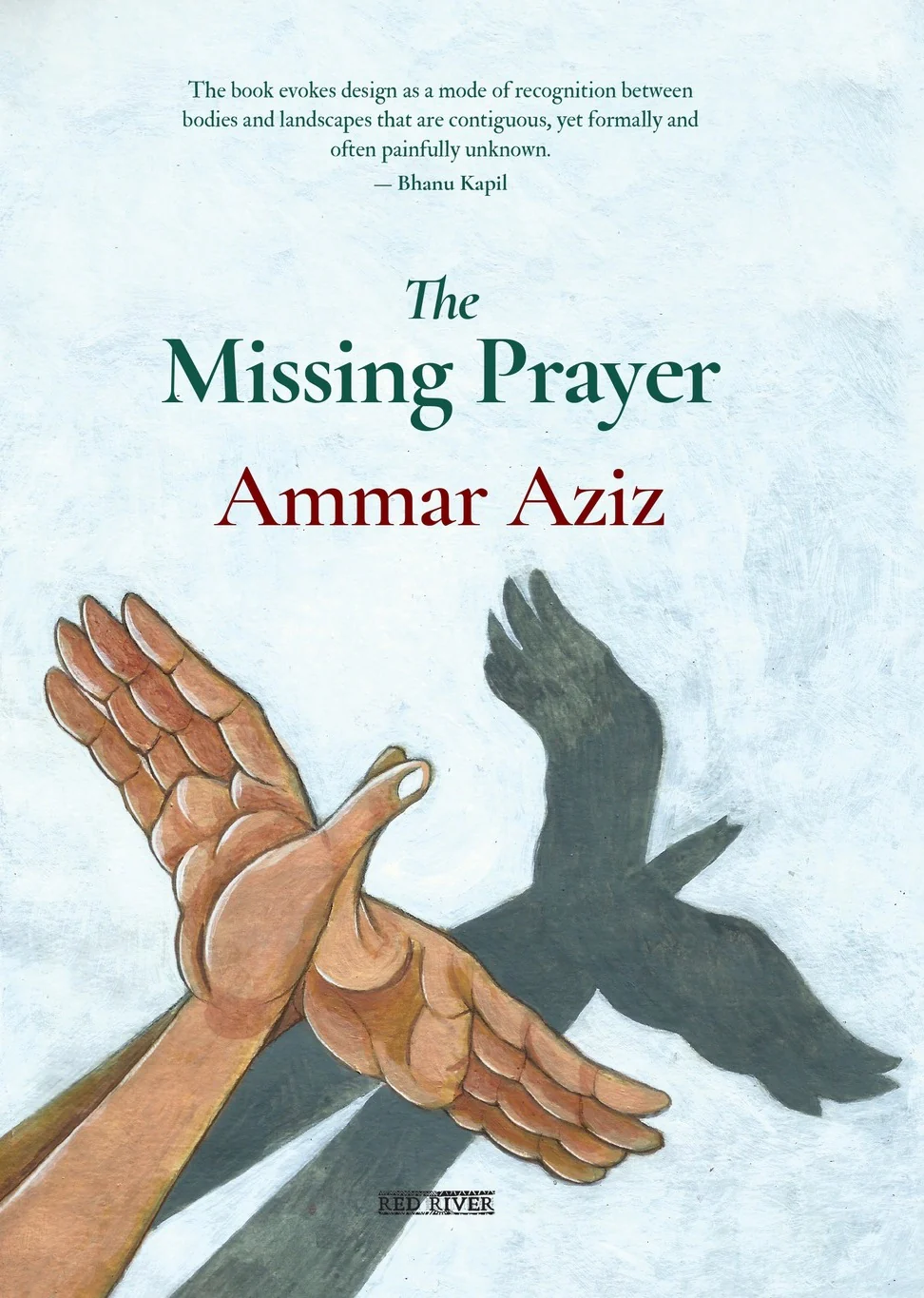
‘How much iron/ does the human body have?’ asks Ammar Aziz, convening The Missing Prayer as equal parts body and map. Uncrumple the map and write in the creases that paper makes. Like an exquisite corpse, what follows each crease might be information, intense somatic data, or conversely: “fragments,” “ugly pathways,” “melody…beyond matter.” In this way, the book evokes design as a mode of recognition between bodies and landscapes that are contiguous, yet formally and often painfully unknown. — Bhanu Kapil
Informed, philosophical, at times indignant and humorous at others, laughing at the divides we humans create to our own peril, these poems deal with a wide range of themes and emotions- from the diverse ragas of Hindustani music and the indescribable charm of Urdu language to the patient mujawar and the missing prayer mat, a musician’s murder, and a communist’s will, from lust and seduction to kleptomania and genocide, all with a kind of detachment so rare in poets. Rich in thought and imagery, Makhdoom Ammar Aziz’s poems stand apart from the mainstream of English poetry written by the poets of the subcontinent. — K. Satchidanandan
I continued to marvel at the precision with which Aziz uses even the simplest words to turn them into poetry. Whether the poems I read are longish, like ‘The Dargah at Night’ or short, like ‘Two Women’ and ‘Lust’, or those filled with emotion, like ‘This mud is our foremothers’ blood’ and ‘We burst into tears’, that precision was there. I greatly enjoyed reading the book; it brought me fresh news and fresh air from across the border. — Adil Jussawalla
Ammar gives us an intimate history of objects that is possible only in the best kind of poems: a pan, a ‘dim yellow bulb’, a ‘twenty rupee note’, dead batteries, a prayer mat, beads, wood, ittar, skin, all of these on their way to martyrdom. These are poems whose afterlife is like – to borrow a metaphor from Ammar – ‘chaashni’, or ‘a dreamy state of slumber while still awake’. — Sumana Roy
Aziz chronicles the extraordinary and the mundane with a sensibility that straddles both tradition and modernity. One can glimpse in these poems the full range of the poet’s voice, exploring moods, ideas, and moments and carving out their inherent poetry. — Musharraf Ali Farooqi
Ammar Aziz is a poet and filmmaker from Lahore. His poetry—widely published and anthologised has been translated into Russian, Spanish, Bangla, Tamil, Kannada, and Urdu. He has participated in several literature festivals and artist residencies, including a writer-in-residence fellowship at Akademie Schloss Solitude, and was recently accepted into the University of East Anglia’s Master’s program in Creative Writing. As a filmmaker, his acclaimed feature-length documentaries, A Walnut Tree and Discount Workers, have been showcased at major film festivals around the world. His work has earned accolades such as the FIPRESCI Award, the Grand Prix at the Moscow International Documentary Film Festival, and the Prix Monde en Regards at the Jean Rouch International Film Festival. The Missing Prayer is his debut poetry collection.
Pages: 138
Category: English
‘How much iron/ does the human body have?’ asks Ammar Aziz, convening The Missing Prayer as equal parts body and map. Uncrumple the map and write in the creases that paper makes. Like an exquisite corpse, what follows each crease might be information, intense somatic data, or conversely: “fragments,” “ugly pathways,” “melody…beyond matter.” In this way, the book evokes design as a mode of recognition between bodies and landscapes that are contiguous, yet formally and often painfully unknown. — Bhanu Kapil
Informed, philosophical, at times indignant and humorous at others, laughing at the divides we humans create to our own peril, these poems deal with a wide range of themes and emotions- from the diverse ragas of Hindustani music and the indescribable charm of Urdu language to the patient mujawar and the missing prayer mat, a musician’s murder, and a communist’s will, from lust and seduction to kleptomania and genocide, all with a kind of detachment so rare in poets. Rich in thought and imagery, Makhdoom Ammar Aziz’s poems stand apart from the mainstream of English poetry written by the poets of the subcontinent. — K. Satchidanandan
I continued to marvel at the precision with which Aziz uses even the simplest words to turn them into poetry. Whether the poems I read are longish, like ‘The Dargah at Night’ or short, like ‘Two Women’ and ‘Lust’, or those filled with emotion, like ‘This mud is our foremothers’ blood’ and ‘We burst into tears’, that precision was there. I greatly enjoyed reading the book; it brought me fresh news and fresh air from across the border. — Adil Jussawalla
Ammar gives us an intimate history of objects that is possible only in the best kind of poems: a pan, a ‘dim yellow bulb’, a ‘twenty rupee note’, dead batteries, a prayer mat, beads, wood, ittar, skin, all of these on their way to martyrdom. These are poems whose afterlife is like – to borrow a metaphor from Ammar – ‘chaashni’, or ‘a dreamy state of slumber while still awake’. — Sumana Roy
Aziz chronicles the extraordinary and the mundane with a sensibility that straddles both tradition and modernity. One can glimpse in these poems the full range of the poet’s voice, exploring moods, ideas, and moments and carving out their inherent poetry. — Musharraf Ali Farooqi
Ammar Aziz is a poet and filmmaker from Lahore. His poetry—widely published and anthologised has been translated into Russian, Spanish, Bangla, Tamil, Kannada, and Urdu. He has participated in several literature festivals and artist residencies, including a writer-in-residence fellowship at Akademie Schloss Solitude, and was recently accepted into the University of East Anglia’s Master’s program in Creative Writing. As a filmmaker, his acclaimed feature-length documentaries, A Walnut Tree and Discount Workers, have been showcased at major film festivals around the world. His work has earned accolades such as the FIPRESCI Award, the Grand Prix at the Moscow International Documentary Film Festival, and the Prix Monde en Regards at the Jean Rouch International Film Festival. The Missing Prayer is his debut poetry collection.
Description
Pages: 138
Category: English
‘How much iron/ does the human body have?’ asks Ammar Aziz, convening The Missing Prayer as equal parts body and map. Uncrumple the map and write in the creases that paper makes. Like an exquisite corpse, what follows each crease might be information, intense somatic data, or conversely: “fragments,” “ugly pathways,” “melody…beyond matter.” In this way, the book evokes design as a mode of recognition between bodies and landscapes that are contiguous, yet formally and often painfully unknown. — Bhanu Kapil
Informed, philosophical, at times indignant and humorous at others, laughing at the divides we humans create to our own peril, these poems deal with a wide range of themes and emotions- from the diverse ragas of Hindustani music and the indescribable charm of Urdu language to the patient mujawar and the missing prayer mat, a musician’s murder, and a communist’s will, from lust and seduction to kleptomania and genocide, all with a kind of detachment so rare in poets. Rich in thought and imagery, Makhdoom Ammar Aziz’s poems stand apart from the mainstream of English poetry written by the poets of the subcontinent. — K. Satchidanandan
I continued to marvel at the precision with which Aziz uses even the simplest words to turn them into poetry. Whether the poems I read are longish, like ‘The Dargah at Night’ or short, like ‘Two Women’ and ‘Lust’, or those filled with emotion, like ‘This mud is our foremothers’ blood’ and ‘We burst into tears’, that precision was there. I greatly enjoyed reading the book; it brought me fresh news and fresh air from across the border. — Adil Jussawalla
Ammar gives us an intimate history of objects that is possible only in the best kind of poems: a pan, a ‘dim yellow bulb’, a ‘twenty rupee note’, dead batteries, a prayer mat, beads, wood, ittar, skin, all of these on their way to martyrdom. These are poems whose afterlife is like – to borrow a metaphor from Ammar – ‘chaashni’, or ‘a dreamy state of slumber while still awake’. — Sumana Roy
Aziz chronicles the extraordinary and the mundane with a sensibility that straddles both tradition and modernity. One can glimpse in these poems the full range of the poet’s voice, exploring moods, ideas, and moments and carving out their inherent poetry. — Musharraf Ali Farooqi
Ammar Aziz is a poet and filmmaker from Lahore. His poetry—widely published and anthologised has been translated into Russian, Spanish, Bangla, Tamil, Kannada, and Urdu. He has participated in several literature festivals and artist residencies, including a writer-in-residence fellowship at Akademie Schloss Solitude, and was recently accepted into the University of East Anglia’s Master’s program in Creative Writing. As a filmmaker, his acclaimed feature-length documentaries, A Walnut Tree and Discount Workers, have been showcased at major film festivals around the world. His work has earned accolades such as the FIPRESCI Award, the Grand Prix at the Moscow International Documentary Film Festival, and the Prix Monde en Regards at the Jean Rouch International Film Festival. The Missing Prayer is his debut poetry collection.